
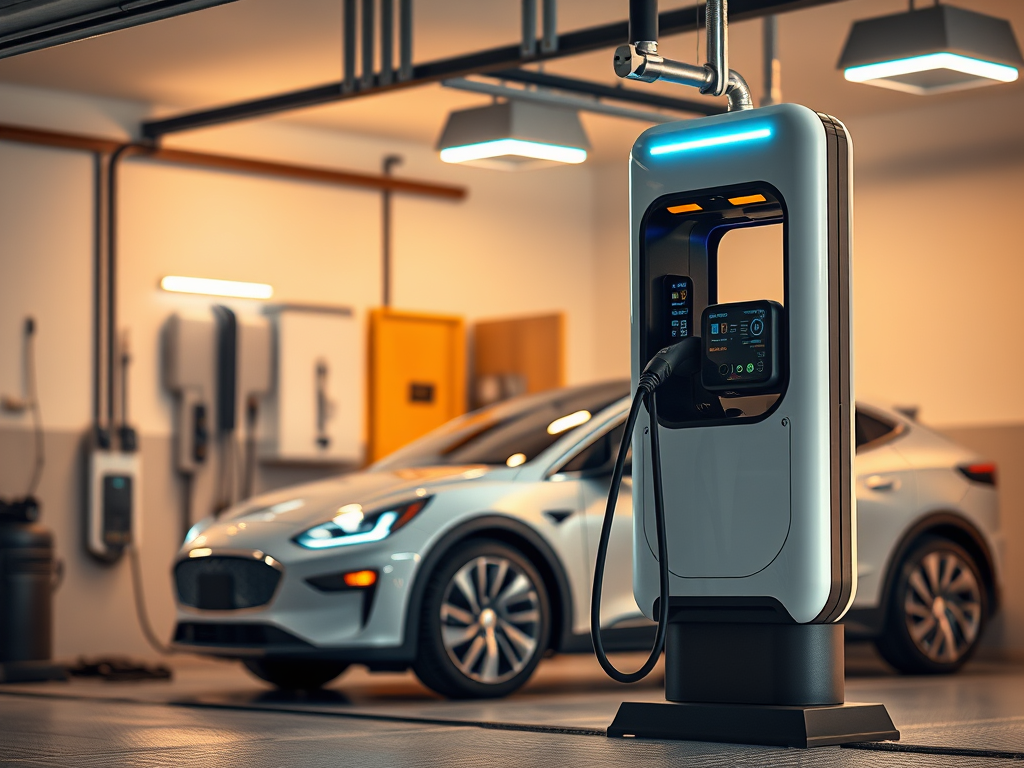
If you recently bought an EV — or you’re thinking about it — one of the first things you’ll want to figure out is home charging. Level 1 charging (your standard outlet) works, but slowly. Level 2 is the real solution: a dedicated 240-volt circuit that charges most EVs overnight. The question we hear most often is: how much does it cost to have a Level 2 charger installed at my house?
Straight answer: most Scottsdale homeowners spend between $500 and $2,500, depending on the run. The range is wide because the job varies significantly depending on where your electrical panel is, how far the wiring has to run, and whether your panel has room for a new 40- or 50-amp circuit. Here is what actually drives the price.
EV Charger Installation Cost in Scottsdale: 2026 Ranges
- Simple install — panel is nearby, no upgrades needed, straightforward garage run: $500–$900
- Standard install — longer wiring run, conduit through garage wall or ceiling: $900–$1,500
- Complex install — subpanel needed, trenching required, or unusually long run: $1,500–$2,500
- With panel upgrade — 100-amp panel upgraded to 200-amp at the same time: $4,000–$6,000+ combined
Ranges reflect residential market pricing as of 2026 and match the figures published on our EV charger installation and panel upgrade pages. Every estimate is free and in writing.
What Determines the Cost?
1. Distance from panel to charger
The single biggest factor. If your electrical panel is in the garage and the charger will be on the same wall, the wiring run might be 10 feet. If your panel is on the opposite side of the house or in a utility room with no direct path to the garage, you’re looking at significantly more wire, conduit, and labor. In Scottsdale, where many homes have the panel in an interior hallway or laundry room, the run to a garage charger can be 40 to 80 feet — which adds up.
2. Panel capacity
A Level 2 charger needs a dedicated 40- or 50-amp circuit. If your panel doesn’t have an open breaker slot with that kind of capacity available, something has to give — either a breaker gets consolidated, a load management device gets added, or the panel gets upgraded. Homes built before 1990 in Scottsdale frequently have 100-amp service, which can accommodate an EV charger but sometimes needs a careful look first. We check this as part of every site visit.
3. Conduit requirements
In Arizona, wiring run through a garage or along an exterior wall typically needs to be in conduit. How much conduit, what type, and whether it needs to be buried are all variables that affect the price. Most standard garage installations are straightforward. Carport installs or runs across a driveway involve more planning.
4. Permit
Scottsdale requires a permit for any new 240-volt circuit. This is not optional — a permitted installation protects you legally and is required to satisfy your homeowner’s insurance. We pull the permit, handle the inspection, and make sure the work is done by the book. The permit fee is typically included in our estimate.
5. Charger brand and type
The charger itself is a separate cost from installation. Many EV owners already have a charger from the dealership or buy one online (ChargePoint, JuiceBox, Emporia, Tesla Wall Connector, and similar). Chargers range from $200 to $800 for quality home units. We install whatever you have, or we can recommend options if you’re starting from scratch.
Do You Need a Panel Upgrade First?
This is the question that makes the biggest difference to the final price. Many Scottsdale homes — particularly those built in the 1970s through 1990s — have 100-amp service. That’s enough for the house as it was when it was built, but adding an EV charger on top of modern HVAC, smart appliances, and home office equipment can push a 100-amp panel close to its limit.
We assess your panel as part of every EV charger consultation. If an upgrade is needed, we’ll tell you upfront and give you an honest combined price. Many of our customers do both at the same time — a 200-amp panel upgrade and EV charger installation in a single visit — and typically save $300 to $600 compared to doing them separately. The panel upgrade itself runs about $4,000 in most Scottsdale homes.
What Vehicle Do You Drive?
The charger compatibility question is usually simpler than people expect. Since 2023, most EV brands have adopted the NACS connector (formerly Tesla’s connector), and J1772 adapters are widely available. We install Level 2 chargers for all major brands:
- Tesla (all models including Cybertruck)
- Ford F-150 Lightning, Mustang Mach-E
- Rivian R1T and R1S
- Chevrolet Bolt, Silverado EV
- BMW, Mercedes-Benz, Audi, Hyundai, Kia
- Any vehicle with a J1772 or NACS inlet
Level 1 vs. Level 2: Is Upgrading Worth It?
Level 1 (standard 120-volt outlet) adds 4 to 5 miles of range per hour. If you drive fewer than 40 miles a day and plug in every night, Level 1 can technically work. Most people find it frustrating in practice — you come home low, plug in, and still wake up below full.
Level 2 (240-volt dedicated circuit) adds 20 to 30 miles of range per hour. Plug in when you get home, wake up fully charged. The cost difference between Level 1 and Level 2 installation — roughly $500 to $900 in most cases — pays for itself quickly in peace of mind alone. Most EV owners who switch to Level 2 say they wish they’d done it sooner.
Why Scottsdale Homeowners Choose Sparks by Rabbit
Neil Goldsberry is the owner and the electrician on every job. When you call Sparks by Rabbit, you talk to Neil. When we show up to do the work, it’s Neil. No dispatched crews, no subcontractors — just an owner who cares about the work because his name is on it.
- ROC licensed and insured — Arizona Registrar of Contractors, license #350139
- 90+ five-star Google reviews from Scottsdale homeowners
- BBB Accredited, A+ rating
- Free written estimates — no obligation, no pressure
- Permitted work — every 240-volt circuit is done by the book
- Panel upgrades too — one contractor if your panel needs work
Ready to Get a Real Number?
We offer free on-site estimates. You get a written price before any work is scheduled. Most installs are completed within a week.
Leave a Reply